Reflecting on 2025
By Sarah Bell
Somehow we find ourselves in December again, with 2025 drawing to a close. In what has been a challenging and distressing year in many ways, nationally and globally, I continue to be incredibly grateful for the kindness and compassion of the people and communities we’ve met through Sensing Climate.
One of our wonderful Glasgow creative writers shared a book with us, called The Book of Gifts. There are many words within the book that resonate, but these stood out in the present moment, “Maybe it feels like a lot because it is”.
When things feel a lot, it becomes more important than ever to come together to imagine different ways of being and living and doing. We’ve lost two of our disability justice greats this year – Patty Berne and Alice Wong – and I find myself leaning to their wisdom:
“I am living in a time where disabled people are more visible than ever before. And yet while representation is exciting and important, it is not enough. I want and expect more. We all should expect more. We all deserve more” (Alice Wong)
“In order to value others, we have to know our own worth. In this historical moment, we have to fight for the valuable lives of butterflies and moss and elders. Because our lives - and all life - depend on this. We must move beyond our cultural beliefs that tell us we are worth only as much as we can produce. Just as each component in Earth’s ecosystem plays a vital role in supporting everything around it, so do each of us have an essential role to play in sustaining our communities, our environment, our planet” (Patty Berne)
Sensing Climate is a tiny drop in the ocean of the world’s workings, but we continue to try to create and sustain community, and to highlight how our responses to climate breakdown do not have to reproduce the ableism that permeates so much of society as it is now.
Cultivating Conversation…
We have enjoyed five ‘Disability and Climate: In Conversation With’ events this year with the wonderful Abhishek Kumar, Angela Frederick, Raven Cretney, Louise Kenward and Dan White. You can tune into the videos and transcripts of those sessions via the Sensing Climate ‘Events’ page, and we’ll be posting news of upcoming speakers for the series in 2026 too.
We also launched our ‘Crip Up Climate Conversations’ guidance in Bristol in October. The idea for this guidance came from early discussions with project advisor, Emma Geen, back in 2021, when very little was being done around disability and climate change. When not framed out of discussions about climate change, disabled people were often framed simply as one of several ‘climate vulnerable’ groups, with little reflection on the social, political and economic systems that create vulnerability. This is not to say that vulnerability doesn’t exist. It does. But vulnerability is created by our society not by our bodies, and it doesn’t have to be that way.
The single story of vulnerability also overlooks the rich knowledge and skills of disabled people within climate action. Climate change is disabling; it is making our world more uncertain, more unpredictable, more harmful. Yet the people who know what it means to navigate a disabling world – disabled people – are so often left out of this work.
Stories have powerful effects on how we understand the world. They may echo existing stereotypes and expectations of how people live – or ‘should’ live – in the world. Or, they can be used to resist these; and to widen out whose lives, and ways of living, are valued and respected.
We can look beyond stereotypes, beyond single stories. We can make space to really listen to each other, to hear and understand what each of our lives actually look and feel like and why. The Crip Up Climate Conversations guidance aims to support people in creating those spaces to share and to listen to each other.
There are four guidance notes, for people who would like to initiate conversations around climate action and disability with:
Disabled people and Disabled People’s Organisations (DPOs);
People involved in the climate and environmental movement who might not understand disability or the knowledge that it brings;
Policy and decision-makers;
People who would like to co-produce a community climate action plan with disabled people.
Each note is available in a range of formats, including standard pdf, standard word document in large print, plain language pdf, plain language word document in large print and Easy Read pdf, with BSL translations on their way in the new year.
You can find out more and access the guidance online.
Disability and Climate in Bristol
Through this year, we’ve been wrapping up our fieldwork and analysis in Bristol. We will be sharing a report that brings together the key findings next year but some highlights along the way have included:
Holding our second disability and climate roundtable, organised in collaboration with the Bristol Climate & Nature Partnership in May. This was one of several roundtable events organised as part of their Climate and Disability programme this year.
Participating in Emma Geen’s ‘Crip Climate Craftivism’ project, initiated in her role as a ‘Personal to the Planetary’ (P2P) fellow with the University of Bristol. Emma brought together a small group of activists who identify as disabled or having a chronic illness to discuss and take action on disability and disaster planning. Inspired by the Craftivist’s Collective project ‘Don’t Blow it’, the group embroidered handkerchiefs with letters and messages advocating for disabled people and people with chronic illness to be included in disaster planning around climate change. These were gifted to national and local decision-makers to influence them to take action on inclusive disaster planning. Emma very kindly invited me to embroider a handkerchief, which went off to Pat McFadden as he was leading the UK National Resilience Review at the time. The experience certainly took me out of my comfort zone, having not picked up a needle for about 30 years, but it was a joy to be alongside such a thoughtful group of people. While Pat is yet to reply (!), you can access a copy of the letter that was sent with the handkerchief here.
Participating in the wonderful Climate Justice in Action mini podcast series by Ruth Nortey, which can be accessed online, alongside a zine, exploring how disabled people and people from global majority communities are represented in climate action.
Launching our Crip Up Climate Conversations guidance in the ‘Climate and Disability Showcase’ event organised by the Bristol Climate & Nature Partnership in October. At the showcase event, we were also really excited to hear about the launch of the refreshed disability-led Bristol Community Climate Action Plan, an important new report by the Centre for Sustainable Energy on how to improve home energy retrofits with and for disabled people, brilliant work by Redcatch Community Garden in facilitating a range of nature and food activities with disabled people, and a new community toolkit ‘Realising Our Inclusive Transport Vision’ that was produced in partnership with Walk Wheel Cycle Trust (formerly Sustrans).
Emma and I have been drawing on this work to develop a new set of resources that are designed to support local authorities to understand the impact that climate and nature projects can have on disabled people. The resources feature recommended actions that can be taken to make projects fairer with and for disabled people. As well as themed resources on transport, housing and energy, emergency preparedness, green jobs, waste, nature and food, there are supplementary resources on co-production and inclusive engagement. Watch this space for those in early 2026!
Disability and Climate in Glasgow
We have also been really excited to start our fieldwork in Glasgow this year, our second case study city! In May and June, Andy and I worked with the wonderful Glasgow Disability Alliance to run three themed ‘lunch and chat’ events, where we introduced the project and had great discussions about nature and disability, housing and energy, and emergency preparedness.
Those discussions set the stage for a series of creative writing workshops, led by Tanvi from July to October. Some lovely writing has been taking shape since, which we’ll be excited to share along with the Bristol creative writing pieces in 2026. My cheeks were certainly feeling all the laughter after our in-person creative writing session at Halloween, filled with blessings, spells, pumpkins and more!
Rebecca and artist, Andy Bolton, stepped in from October to start the co-creation of the Glasgow Sensing Climate mural. The workshops have led to a bold mural design, full of Glasgow’s characteristic humour, care and feistiness, which we’re looking forward to painting and launching in 2026.
It’s also been a pleasure to meet everyone who has taken part in a 1:1 project interview so far. These will be ongoing into 2026 so there’s still time to take part if people would like to.
The analysis of Glasgow’s climate – and related - policies is well underway, and we will be drafting a response to the consultation that has just opened on Glasgow City Council’s new Climate Plan. We’d be happy to share our draft in the new year in case of use to others who are keen to respond.
Disability and Climate in Scotland
Running in parallel with our Glasgow work has been an analysis of Scotland’s climate policy landscape, working with both climate-specific policy areas and those with wider relevance to climate action within Scotland, for example in areas of emergency preparedness planning, housing, transport, green infrastructure, green jobs and waste reduction. For each policy, we have examined:
To what extent is disability explicitly considered?
In what ways, if at all, is disability considered in relation specifically to climate risks, environmental sustainability and/or climate-related action?
To what extent are disability rights, disability knowledges and the participation of disabled people discussed in relation to climate action and policy?
What, if any, tangible measures for disability-inclusive climate action/policy are apparent?
Is there evidence of engagement with disabled people in the development of the policies?
What are the implications of the policies set out for disabled people?
We are currently drawing on this work and our ongoing fieldwork in Glasgow to respond to the Scottish Government consultation on their new Draft Climate Change Plan.
It’s been a pleasure to work with project partners, Inclusion Scotland and the Environmental Rights Centre for Scotland, to develop a briefing about the degree to which disabled people’s needs and priorities are being met within Scotland’s climate and emergency planning policies. In November, we ran a workshop to bring disabled people together, both in person and online, to discuss people’s views on this topic, to refine the briefing and identify priorities for influencing the Scottish Government’s climate and emergency planning policies going forward. There is more information about the workshop online, and we will be launching the briefing in a dedicated event on disability and emergency planning in Scotland in June 2026.
Disability and Climate in South Dunedin, Aotearoa New Zealand
This year, we also began the fieldwork for our fourth case study in South Dunedin, Aotearoa New Zealand, with super collaborators, Dr Raven Cretney (Lincoln University), Áine Kelly-Costello (independent researcher) and advisor Scout Barbour-Evans (Te Kahukura Puāwai Limited).
South Dunedin is one of New Zealand’s most exposed communities to sea level rise and extreme weather events, and is where much of Dunedin’s accessible housing is located. Disabled residents face significant challenges in adapting to climate change, including the need for more inclusive emergency management as well as meaningful involvement in adaptation decision-making, particularly for decisions on contentious issues such as managed relocation in response to flood risk. The ongoing ‘South Dunedin Future’ programme is a joint initiative between Dunedin City Council and Otago Regional Council to develop community-led adaptation.
However, there remains little research on disability, flooding and managed relocation – within this geographical area or elsewhere. This year, Raven and Áine have been immersed in a series of in-depth interviews with people in South Dunedin’s disability community, the emergency management sector and policy makers. These interviews will be continuing into early 2026, with the aim of identifying opportunities to build adaptive capacity and better embed the perspectives of disabled people in climate adaptation decision-making.
Steered by Raven, we had the pleasure of co-convening a hybrid conference panel session at the Adaptation Futures Conference in Ōtautahi Christchurch, to reflect on the importance of this area of work. The panel included Áine and Suzanne Phibbs in person, with myself, Katherine Lofts and Michelle Villeneuve joining online, as part of a wider session chaired by Petra Tschakert.
A Change in the Climate
Funded by the Leverhulme Trust and Arts Council England, it has been wonderful to continue our work with creative arts organisation, Roaring Girl Productions (RGP), to encourage diverse audiences to think with, relate to and become involved with the questions raised across the Sensing Climate project.
RGP, lead artist Liz Crow and the creative team have been immersed in a series of small-scale performance actions over this year for ‘A Change in the Climate’, each exploring a range of themes relating to climate change and disability. These include:
Disabled people’s historical context
Different value placed on different lives
Framing and representation
Nature connectedness
Mutual aid
Harnessing knowledge
Responsive policy
The work has taken them far and wide, from Somerset and Sussex to South Wales, Nottinghamshire and the Cairngorms. The actions speak to existential questions at the heart of disability and the climate crisis; who gets framed out and whose needs are centred, who gets to live and who gets discarded, how do we make space for joy and remember why the world is worth fighting for?
With one more action to go, the team will be taking some time to recover in early 2026, before curating the exhibition and taking it on tour through 2027. We will keep you updated but in the meantime here are a few photos from behind the scenes…
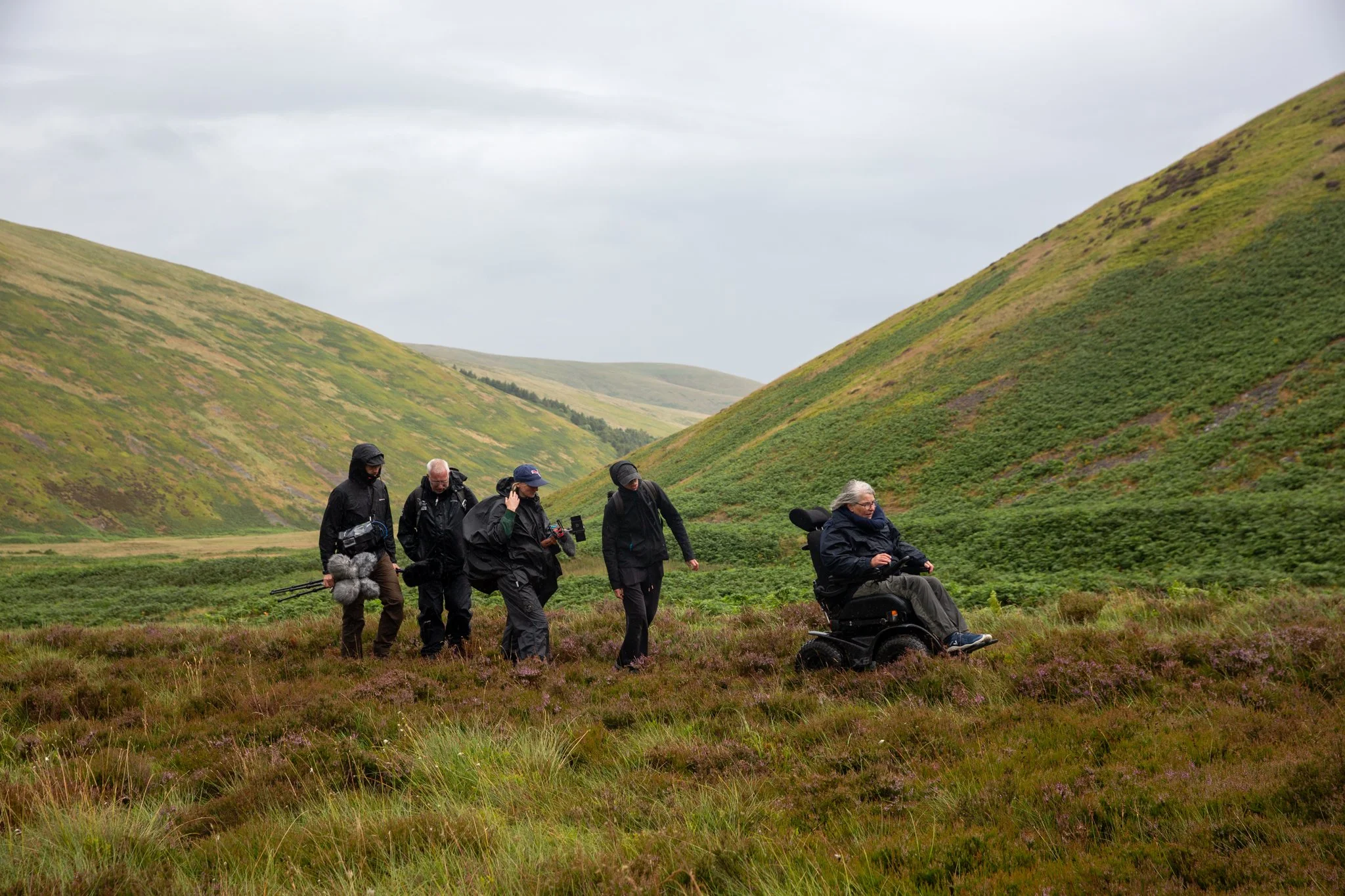
Image credit: Roaring Girl Productions and Suzie Larke
Image caption and description: Behind the scenes in the creation of ‘Joy’ - the photo shows Liz in her power chair leading the creative team, navigating tufty grasslands, surrounded by rolling green hills set against a grey sky. Everyone is fully wrapped up in warm, waterproof clothing.
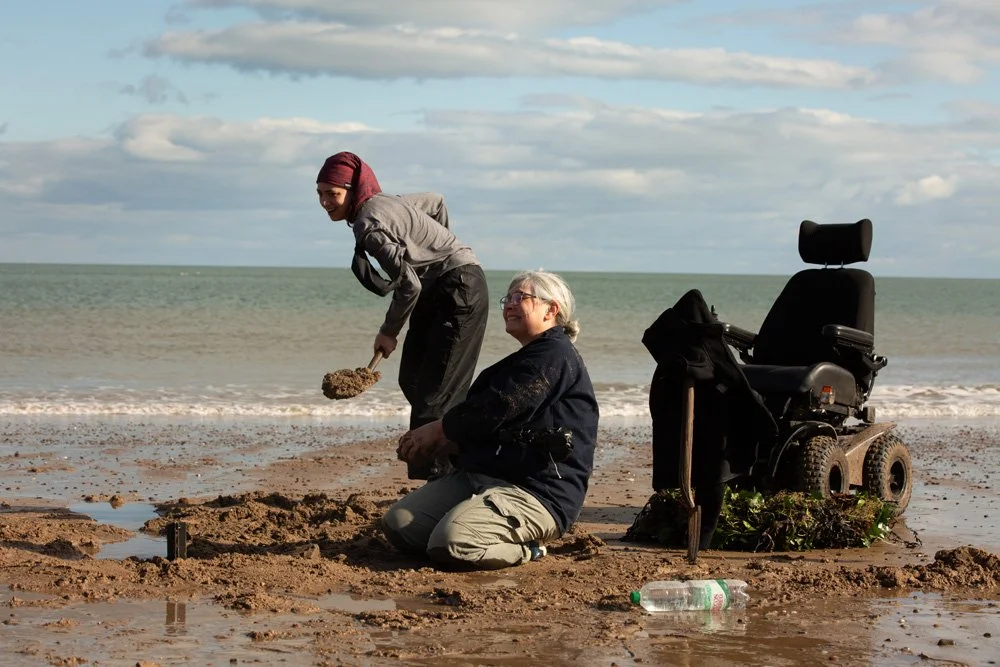
Image credit: Roaring Girl Productions and Suzie Larke
Image caption and description: Behind the scenes in the creation of ‘Framing’. Liz is kneeling down with her hands covered in sand, at the shoreline, laughing, with her power chair and a water bottle closeby. Another member of the team is standing beside her, also smiling and wielding a sand-covered spade. The sea is calm with blue sky and wispy clouds in the background.
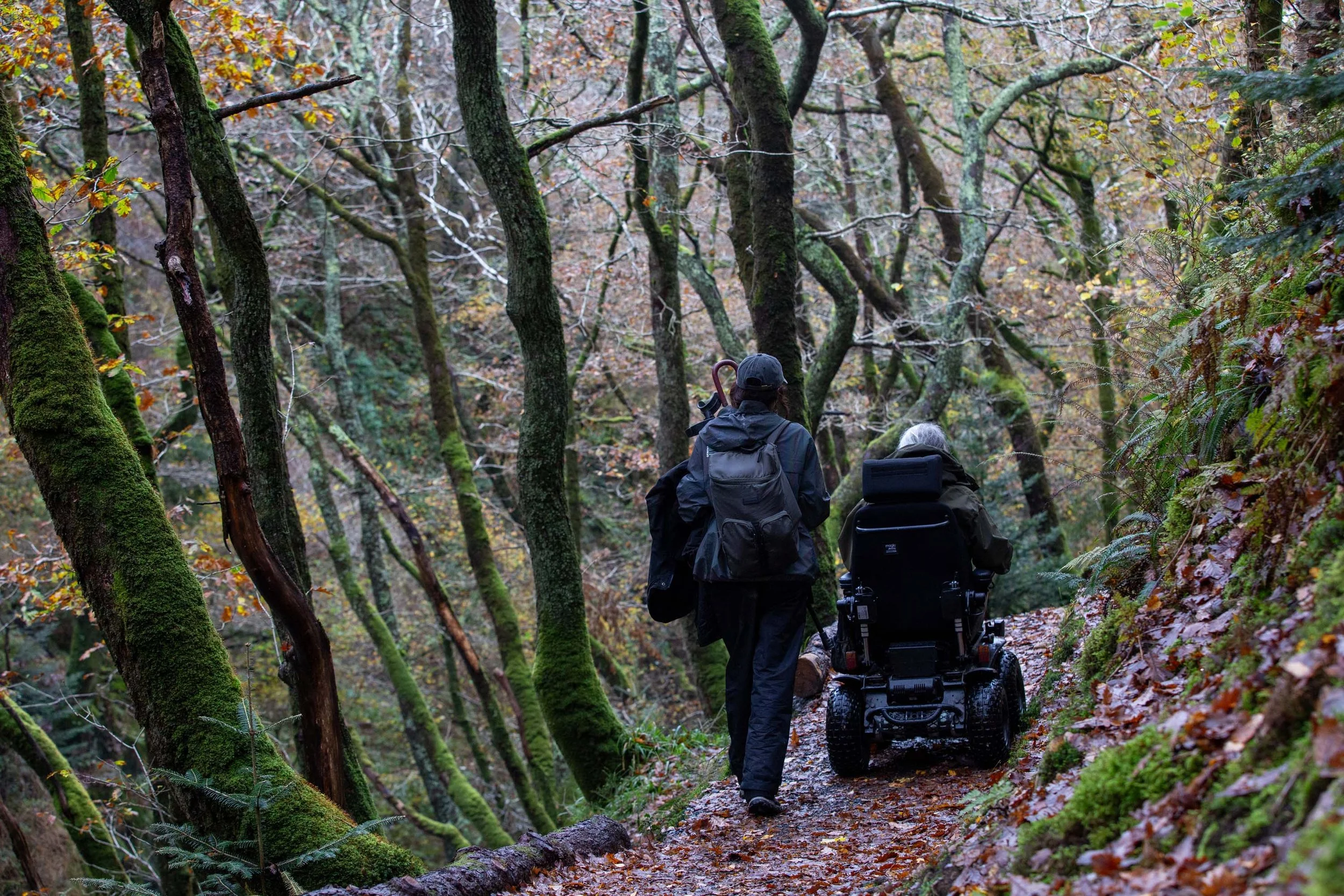
Image credit: Roaring Girl Productions and Suzie Larke
Image caption and description: Behind the scenes in the creation of ‘Weave’. Liz is wheeling along a narrow path through a woodland next to a member of the creative team who is walking just behind her. The path is littered with fallen autumn leaves, and the trees are covered in moss and lichen.
Writing and Reflecting
Although it’s been a busy year, we have tried to capture some of our thoughts in writing along the way.
Andy led on our first Sensing Climate Working Paper which examines the evolution of disability equality legislation; from the passing of the Disability Discrimination Act (DDA) in 1995 to the introduction of the Equality Act and Public Sector Equality Duty (PSED) in 2010. Drawing on the policy areas of housing and transport, in particular, the paper reflects on whether the PSED is fit for purpose in ensuring the rights of disabled people are met, and shares examples of where the needs and priorities of disabled people have been given limited, if any, consideration. It goes on to consider how the world might look for disabled people across these policy sectors, had public bodies – at various levels of government – taken action to promote equality of opportunity amongst disabled people, in line with the ambitions of the Disability Equality Duty that was introduced when the DDA was amended in 2005.
Andy extended this discussion in a talk as part of the Housing Learning and Improvement Network (Housing LIN) webinar, “30 Years on: Reflecting on the Disability Discrimination Act and the road ahead”. He reflected on how the PSED may also have impacted, with very real-world consequences for disabled people, the area of emergency preparedness policy and planning, and has written a short news piece about this talk that can be accessed online.
Alice, Andy and I have been expanding on this work to develop an academic paper that we hope to submit to a journal in early 2026, which examines the limitations of the PSED for ensuring that the needs, priorities and rights of disabled people are embedded in climate adaptation policy and decision-making in England. After charting key shifts in disability rights legislation in England, we draw on the qualitative and documentary analysis conducted in Sensing Climate so far to reflect on what is enabling and/or hindering meaningful involvement of disabled people in climate adaptation in England, alongside opportunities for improvement.
In other writing, Rebecca and I drafted a paper (currently under review) that explores how campaigns promoting individual pro-environmental behaviour change can lead to guilt in ways that alienate and overlook the perspectives of disabled people in climate action. We discuss the need for shared learning and collaboration between environmental, climate justice and disabled people’s movements, to enable accessible forms of activism, that build strength in numbers; sustain care for self and others; and promote visions of new ways of organising society characterised by solidarity, justice and care.
We have drafted two book chapters. One chapter is for a forthcoming book called ‘Lived Experience: Critical Perspectives in a Changing World’. This chapter shares new stories of disability and climate crisis. It foregrounds opportunities for climate responses to build inclusive worlds, while also recognising the risks of trying to imagine alternative futures when routinely harmed by the world we currently live in.
The other is for a forthcoming book called ‘Disability and the Making of Place’. Written in collaboration with Kate Morley, it draws on Sensing Climate and on Kate’s PhD to reflect on how climate emergency or crisis framings risk excluding disabled people, both from decision-making settings and from settings where people go to find peace and solace in the face of everyday challenges. It highlights the need to witness the harm and pace of climate and ecological breakdown without discarding the bodies and landscapes that show the scars; to live together in ways that both challenge the drivers of crisis and respect the right to create and sustain a sense of home in increasingly fragile landscapes. It was great to present some of this work at the Nordic Network on Disability Research conference in May.
Building on a blog piece that I wrote back in 2023, I was also really touched to be invited to give an online keynote lecture at the 2025 annual general meeting of the Disability Specialty Group of the American Association of Geographers in March. We are now developing this talk into a paper that sets out how and why the exclusion of disabled people from climate adaptation research and policy contributes to ‘epistemic injustice’; a form of injustice that fails to recognise and affirm the important knowledge contributions of disabled people to this work.
These ideas informed a paper that has just been published by the journal, Climate and Development, which was led by project advisor, Siri Eriksen. The paper is called “Between a rock and a hard place: Exploring the lived experience of disability and climate injustice” and draws on fieldwork conducted with collaborators in rural Uganda and Kenya. It was developed, in part, through our MSc module on ‘Disability, social justice and climate resilient development’. We will share a short news piece about the paper and its key findings in the new year.
Throughout the year, we have been drafting various work-in-progress summaries of our ongoing policy analysis work. Alice, Andy and I have used those to respond to consultations and evidence calls including, for example, the United Nations Office of the High Commissioner for Human Rights (OHCHR) call for evidence on just transition and human rights in January; the UK Universities Climate Network call for input to the Department for Energy Security and Net Zero Public Participation Strategy in February; the UK Government’s Review of the Fuel Poverty Strategy in April; a Parliamentary Transport Committee Call for Evidence on ‘Joined-up journeys, achieving and measuring transport integration’ in October; a Parliamentary Environment, Food and Rural Affairs Committee Call for Evidence on Climate and Weather Resilience in October, and the Energy Security and Net Zero Parliamentary Committee call for International Climate Policy Evidence in December.
Alice has also been working with project advisor, Sébastien Jodoin, to write a brief for the advisory opinion on climate change at the African Court on Human and Peoples' Rights, which highlights the need for disabled people’s rights to be taken into account by governments in addressing climate change. They wrote a similar brief last year for the European Court of Human Rights ‘Müllner v. Austria’ case, and are planning another to feed into the Court's decision in the upcoming ‘Friends of the Earth v. UK’ case looking at the UK Government’s third National Adaptation Programme.
Other interesting resources
Through the year, we’ve heard about many other resources that may be of interest. We’ve gathered just a few of those here:
CBM Global’s guide for advancing disability inclusive climate action, providing practical strategies to embed disability inclusion across climate programmes, policies and investments.
An Easy Read guide to climate change, produced by get2together and Dynamic Earth.
A short animated film, called ‘Journeys Through Time and Climate’, developed by OpenStoryTellers to share the challenges experienced by learning disabled artists when using public transport, including the impact of extreme weather both now and in the future. The film can be found online: https://greenhealthyfrome.org/watch/
Some great resources on climate change by The Down Syndrome Resource Foundation.
The latest status report by the Disability Inclusive Climate Action Research Programme (DICARP), which analyses how disability rights are being considered in domestic climate policies amongst countries that have signed up to the Paris Agreement.
A literature review exploring how disabled people have been considered in efforts to move towards a green economy, for example, through ‘green jobs’ opportunities.
A forthcoming literature review on disability and climate justice by the Institute of Development Studies.
Resources produced by the US-based Partnership for Inclusive Disaster Strategies to support disability-inclusive disaster risk reduction, preparedness and response.
Angela Frederick’s new book, ‘Disabled Power: A Storm, A Grid, and Embodied Harm in the Age of Disaster’.
Raven Cretney’s scoping work on climate change and disability in Aotearoa New Zealand.
The Year Ahead
We have lots of exciting activities planned for the year ahead. In addition to those noted above across Glasgow, Scotland, England and South Dunedin, we will be starting our Dublin fieldwork from May 2026 in collaboration with CBM Ireland and artist AlanJames Burns. These activities will include ‘lunch & chat’ events, interviews, creative writing workshops, mural co-creation, policy analysis and roundtable events. We are currently scoping ideas for an event on extreme weather, emergency preparedness planning and disability in the wider UK context to complement the work we are doing on this in Scotland. We’ll be continuing our ‘Disability and Climate: In Conversation With’ series, as well as sharing our ongoing work through a range of presentations and writing activities – creative, practical and academic – as opportunities arise.
With the intensity of the project over the last two years, alongside some turbulence in the wider university context, another quote from The Book of Gifts feels somewhat apt:
“My ducks are absolutely not in a row. I don’t even know where some of them are, and I’m pretty sure one of them is a pigeon”.
Recognising this state of play and the accompanying advice that “we all need to take it slow sometimes”, I will be taking much of January as a quiet month, without meetings. But I will keep an eye on emails and respond when urgent, and will hopefully re-emerge with a pigeon and all my ducks in some kind of configuration ready for the rest of 2026!
Throughout the year, we’ll continue to use these news pages to keep everyone updated. These pages are an open space, both for project-related news, but also for anyone who would like to share their activities around disability and the climate crisis – individuals, practitioners, artists, researchers or other organisations working in this area. So if you would like to share, we would love to hear from you – do email Sarah at Sarah.Bell@exeter.ac.uk